16 October 2006

Fête de la Branda!

All the villages around here have their special Fête days. Gorbio has several but the Fête de la Branda, held in October, is my favourite.

It’s a stunning day as October days so often are on the Mediterranean. There’s a clarity to the light on fine autumn days that you don’t get with the heat haze of summer. The sky is a slightly paler version of Matisse blue, the leaves on the trees stand out almost as if they are painted on layers of glass, stuck together to make one of those glass paintings I remember seeing in my grandmother’s house as a child.

I spend my life in jeans, so I don a floaty number, throw a pink scarf around my neck, shut the dogs in the house and drive up to the village. I want to get there early, as it’s always hard to find somewhere to park the car on Fête days. I’m later than I planned and join a steady stream of cars climbing the Route de Gorbio to the village. The car park is full, people are parking anywhere. I cheat. My friend Sheila is away – I know that because I’m caring for her dog, Taco – so I drive up her hidden lane, park my car on the empty patch of land opposite her house and walk down the steep cobbled street toward the main square.
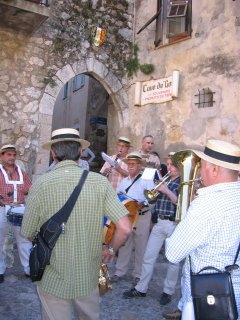
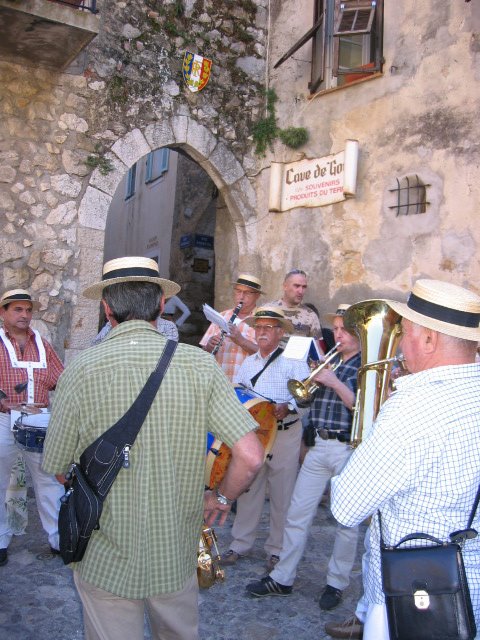
Band at the entrance to the old village

A man is selling beds - four or five large mattresses are laid out on frames on the side of the road. I wonder who on earth buys a mattress at a village fete - someone must because he’s always here. I see the veggie lady from Sospel, a beautiful village 20 kilometres above Menton. Her table displays mounds of Cœur de Bœuf tomatoes, a pile of perfectly round pumpkins and a single enormous courgette. On the ground are cages - one is jammed with live chickens, another has half a dozen quail and a few capons. Yet another has guinea pigs and near the wall she has a cage filled with big fluffy white rabbits. I hope these are for sale as pets and not for dinner. We chat for a bit. I’d bought around 30 kilos of tomatoes from her during this past summer which I made into sauce - chopped up, cooked in olive oil with a little onion and lots of basil. Several dozen little pots now sit in my freezer ready to be poured over ricotta and spinach tortellini on dark winter nights.
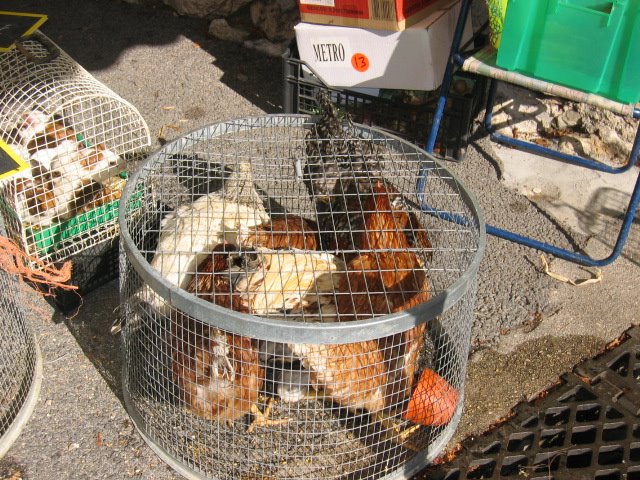
Guinea pigs and chickens for sale

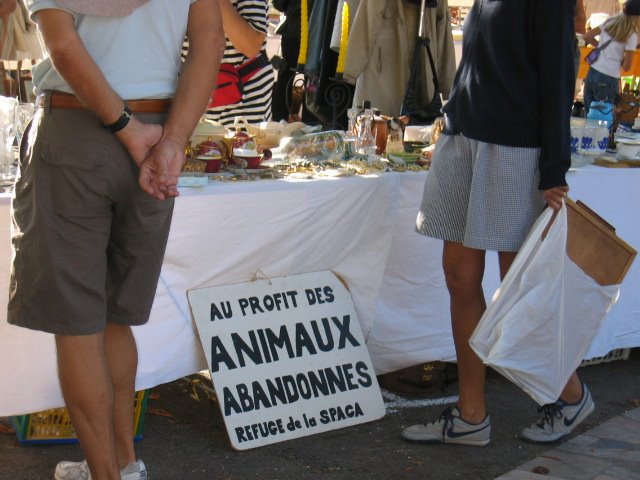
The upper square is home to a Vide Grenier - literally ‘empty the attic.’ There must be sixty or seventy tables spread out under the plane trees, all covered with the leftovers of people’s lives. Indeed, one has some of the detritus of my life – it’s for a dog charity. I walk past rails of old clothes, tables filled with books, mis-matched wine glasses, antique jewellery, a wonky chair. I notice a beautiful hand-beaten copper bowl. I’m tempted but walk on. I’ve got too much ‘stuff’ as it is - one of those de-clutter experts you see on the television would have a field day in my house.
I walk down steep steps towards the Place – the main square. Someone has stuck notices on the wide trunk of the elm that was planted in 1713. Beyond is the buzz and energy of Fête day. A band is playing, boom boom boom, happy music.

Elm planted in 1713

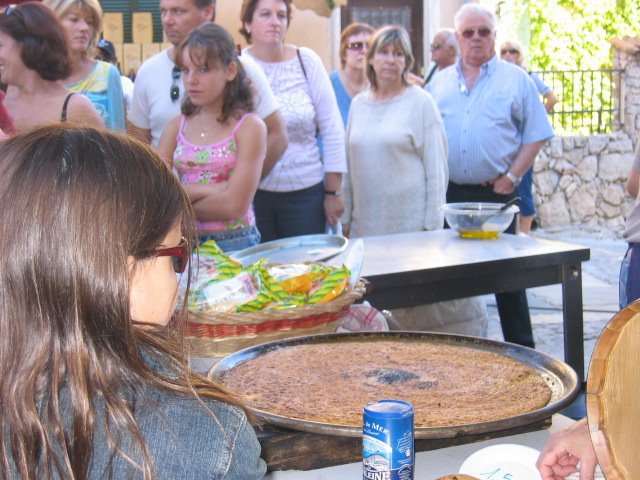
The square is filled with stalls selling produits du terroir: honey, olives, cheeses, olive oil, charcuterie, tapenade, cakes, wines, socca. Socca is a speciality of the south of France and particularly of Nice. It's a sort of large flat pancake made of chickpea flour and olive oil and is cooked in a pizza oven. You season it with black pepper and it's a very cheap and nutritious way of grabbing a quick bite.

Queues for socca

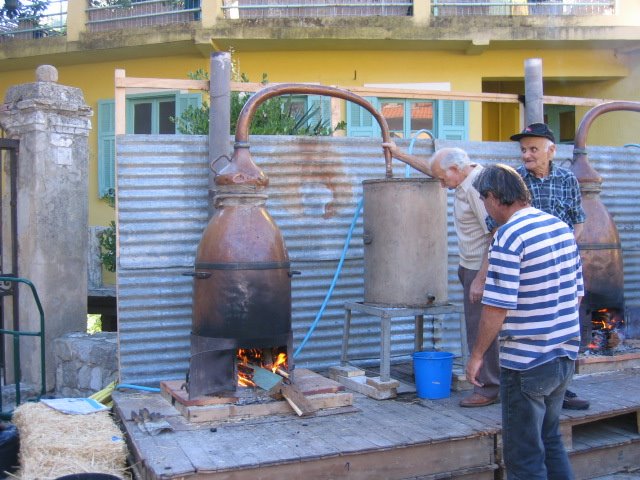
I can’t wait to buy some of the produce but first I walk to the far end of the square, past the fountain, where, just in front of the archway leading up to the medieval village, stand the two alambics – beautiful copper stills. That’s what we are all here for – the Branda. Branda is the Provençal word for marc, the marc de Provence, which actually has two meanings: either the fermented grape pulp, seeds, and stems that remain after the grapes are pressed for their juice, or the actual potent distilled alcohol. The word comes from the Old French marchier, to trample. Many countries have their version of this, for instance in Italy it’s called Grappa.

François and his brother

The right to practice the ancient art of distilling the Branda passes through the same family and I watch François, who is the last bouilleur de cru of the village. He and his brother, who looks a bit like Popeye, pipe and all, work all day distilling the fiery liquid that is available to everyone. I tried this a few years ago and it’s pretty lethal stuff. I desist. I watch as they empty one of the stills and refill it with the fermented grape mush, layered with straw. The stills are heated by wood fires, vapour fills the air and wafts away above the Restaurant Beau Sejour into the hills. And from a small tap, drip by drip, the clear liquid, the Branda, falls into a blue plastic bucket.

TF1 films the still being emptied

The micro calls for the Mayor: ‘Michel, s’il te plaît. Come and meet our friends from TF1.’ TF1 is the main television channel in France and they are filming the making of the Branda. I see the Mayor, dressed in his usual jeans, amble across the Place greeting people as he goes. He’s a short, stocky man, with an attractive energy and twinkle in his eye. He’s an artist of repute and since he’s been Maire, the village now has many cultural activities. He sees me, grins, kisses me on each cheek and asks if I’ve seen the ‘banc.’ He refers to Milou’s bench and I’ll write about this in my next posting.
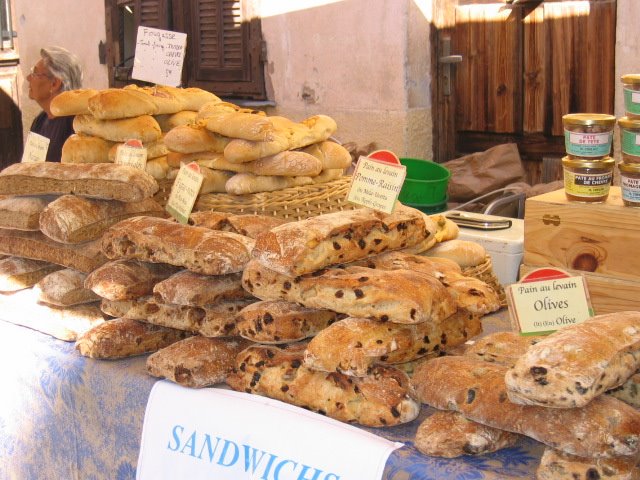
I wander amongst the stalls and buy bread stuffed with figs, bread with apples and walnuts. I buy muffins, a pain d’epice, a goat cheese. Then I see the olive oil man standing in a corner under the silk tree. I normally buy half a dozen bottles but with my still fragile back, can’t carry them to the car. I buy two litres but don’t explain. I should have done so – he looks disappointed. No matter, I’ll call at his house when I need more. I meet his attractive wife – these two are such gentle people. She makes the confitures they sell. Last year I bought apricot jam and a marmelade but both were full of what appeared to be sheets of clear plastic until I realised it was gelatine that hadn’t dissolved. I wonder if I should mention it but don't.

Gorbio's olive oil producer

Someone calls my name and it’s Laurence, who owns Nina, a little Jack Russell cross I look after from time to time. She is sitting at a table outside the Bar Les Terrasses with another lady, who also had a dog, an old bichon she carries around in her knapsack. Laurence, beautiful, slim and elegant invites me to join them. I order a noisette (a small espresso with a little milk added) and share the bag of muffins. Laurence tells me her son is dating the other lady’s daughter. I ask if their children plan to marry. ‘Mais non, they are only 18,’ Laurence says. But it’s obvious they are hopeful. Mothers-in-law to be perhaps? I wonder if their children know.

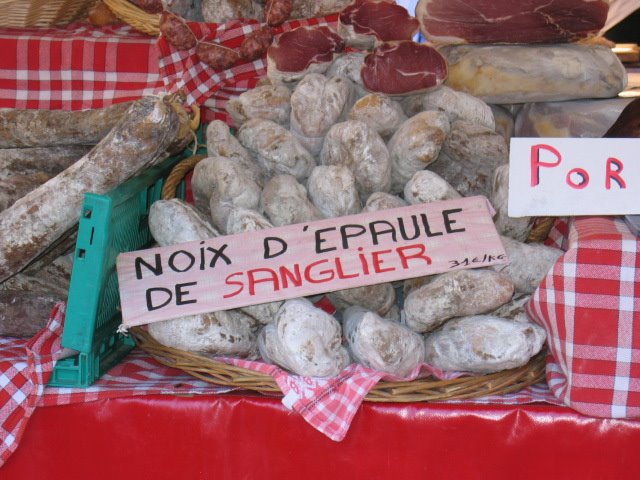
Wild boar

I look at my watch. I must go, get back to the dogs. It takes me half an hour to get out of the village, the cars are still nose to tail trying to get in. I read a few days later in Nice-Matin that 'Les Gendarmes distribuent des prunes.' A prune, apart from being a plum is also argot (slang) for an amende or fine. The police handed out 30 parking fines to visitors. How mean! Everyone knows it’s impossible to park in a medieval hill village. I have no doubt our Maire will have something to say to the Menton gendarmes before next year.

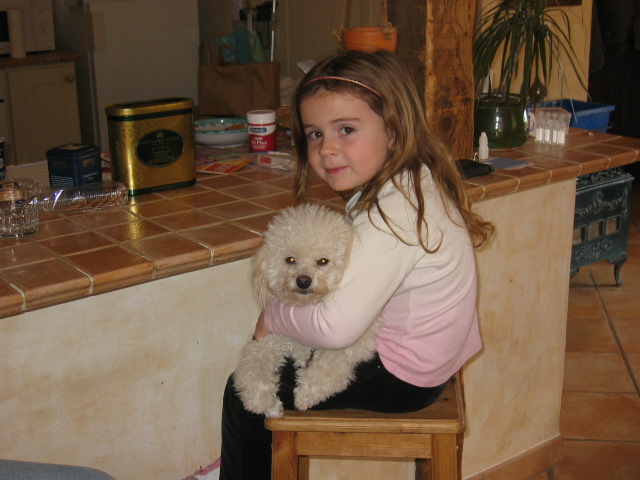
Bichon in bag

03 October 2006

Dem bones, dem bones

Maddie, Penny & Beau

The rain’s gone and the sun is shining, the sky is that perfect Mediterranean blue with the odd powder puff of cloud here and there - and the dogs – well, most of them (we won’t mention Beau) have stopped peeing in the house. All is well in my world. Time to see if my bones have healed.

My neighbour drives me to the x-ray clinic. It’s seven weeks since I fell two metres and landed on my back on the edge of a stone step. You can read about that stupidity in the posting called ‘Gardening can seriously damage your health.’ As we drive down the Route de Gorbio it’s as if I’ve suddenly landed on a film set – lights, action, music. Seven weeks is too long to be stuck in one place. Every bend in the road brings a new vista: the sea, the port of Menton, the blue leaves of the olives glinting in the sunlight, the colours, the smells, it’s almost overwhelming. What must a guy newly out of prison feel?

The x-rays show the fissure in the pubic bone has healed but the four broken bones in my lower back (spurs off the spine) haven’t and each one is now floating at least an inch from where it should be. The doc at the clinic says provided there is no pain, it won’t matter. But it is painful. I wear a corset and that helps a little - it also gives me a nifty waist. I walk from the clinic to see my doctor who gives me an ordonnance (prescription) to see a back specialist.

Zak

I really like Dr. Lamas. She’s always to the point, and always smiling. One of the most difficult things when moving to a new country is finding a doctor, a dentist and a hairdresser, not to mention a bank and a garage you trust. It all takes time. And it isn’t just difficult in a country with a different language. I don’t remember problems when I moved to America but then I was young and probably didn’t think about it too much. Later, when I emigrated to Australia and wore my hair curly and piled up with wispy bits floating about my ears, a bit à la Brigitte Bardot (as if!) every hairdresser was appalled. ‘You’ll not want your hair like this in Australia,’ they said. I kept changing hairdressers and stuck it out for about three years but then they were right: once I moved from Tasmania to Far North Queensland, it was all too much in the heat and I had the lot chopped off.

One day, earlier this summer, Dr. Lamas paid a home visit. I was too sick with a stomach virus to drive down the valley. The fee was peanuts considering the length of journey to me. I offered her more money. She refused but said she’d love some boutures (cuttings) in the autumn. Now, I’ve a couple of dozen young plants ready for her. They need planting in her garden before the autumn rains arrive and she’ll be up soon to collect them. My sort of lady.

She shares the surgery with her ex-husband and so one or other is always on duty for home visits. One time, when my best friend Candy was visiting from America, she fell sick. The husband came on a home visit and she nearly swooned with joy. ‘Oh my,’ she croaked in her fevered state, ‘a Jean-Claude Killy look-a-like with a voice like Maurice Chevalier.’ Candy got better pretty quickly after that visit. Amazing what a dishy French doctor can do for one’s spirits. I quite expect her to fall sick on her next trip to France and I’d best make sure it’s Jean-Claude himself who comes to tend to her. Candy had a poster of J-C Killy in her room at college and she has it hanging in her garage even now. I was just happy for the brownie points I gained in offering such a service to a visiting American.

A week or so later, I get to see the back specialist who tells me that no operation is necessary, indeed possible, but that I need six months balnéothérapie. I call into the clinic in Menton where I’m directed to a dingy basement which has that very distinct swimming pool smell. Funny how smells more than any other sense, can transport you back to the past. Suddenly I’m eleven years old and shivering on the diving board at the St. Alfred Swimming Pool, an Art Deco building in Hove, Sussex, where I used to take diving lessons from Maire Hider, a competitor in the 1948 Olympics. Back to the present and to Menton and to the very sympa doctor on duty who tells me that the balnéothérapie clinic is closing at the end of the month. I ask him why and he gives that familiar French shrug. He directs me to his own office in Carnoles and tells me that rééducation (rehabilitation), without water, will be just fine. I’m not sure what to do. I know water therapy would be good but I know the nearest clinic for that is much further away and it’s often so difficult to leave the dogs for more than an hour or so.

I walk toward the address I’ve been given, ring the bell and the door is opened by a good-looking young man who is the kinésithérapeute (physiotherapist) on duty. What am I saying? He’s not just good looking, he’s a vision of perfect manhood. I look at him, a beautiful slim Frenchman in blue jeans and decide to go no further. I think of Candy’s recovery with her Jean-Claude Killy look-a-like and know I’ll be just fine, thankyou, with this gentleman. In fact, Bruno is a brilliant kiné and trés sérieux, which is how the French say 'responsible.' He’s teaching me exercises to help support the damaged area. I work hard on stomach and lower back muscles and it’s damned painful at times, but when he praises me for doing an exercise correctly, I positively purr with pleasure. And when he massages my back, I wonder what could possibly be wrong in falling two metres onto the edge of a sharp stone step.

20 September 2006

A Day in the Life

Beau, formerly known as Bimbo

‘I’d love to run a dog hotel like you,’ they say. I smile and nod. ‘Just feed the dogs twice a day and then play with them – nothing else to do.’ I nod. ‘You’re so lucky,’ they say. ’What you do is my idea of heaven – you spend all day long with dogs and you get paid for it.’

Beau in the garden

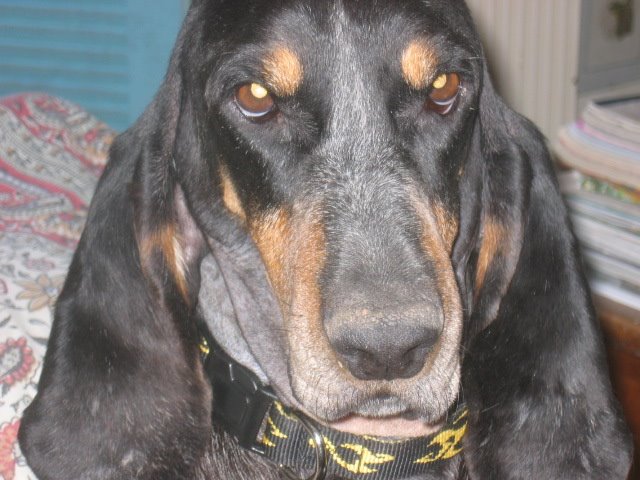
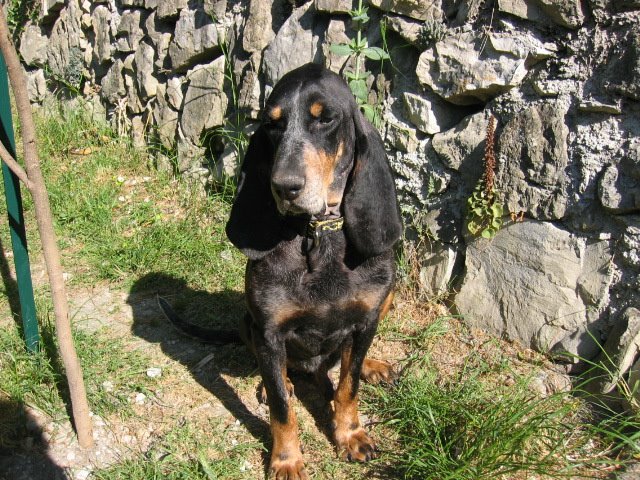
It’s six in the morning, still dark: I let the dogs out. Beau won’t go down to the garden. It’s raining, the third day of rain. The garden is grateful but I’m not sure I am. Beau, the Bruno de Jura who came to live here from the refuge doesn’t ‘do’ rain. Here is a dog who has had four homes before coming to me, who lived for several years in a run-down refuge and who is now living in the lap of luxury. The biggest decision in his day is whether to sleep in my chair or make a mammoth effort and move to the sofa, and now I discover he doesn’t do rain. I try to understand him: after all, he lived in dreadful conditions in the refuge, but Beau, this is not a dog kennel and you don’t pee in the house! But I can’t get mad at this dog – he’s obviously been beaten. If I pick up a broom to sweep the floor, he cringes. I’ll need to put on my dog psychology hat but for the moment, there isn’t time.

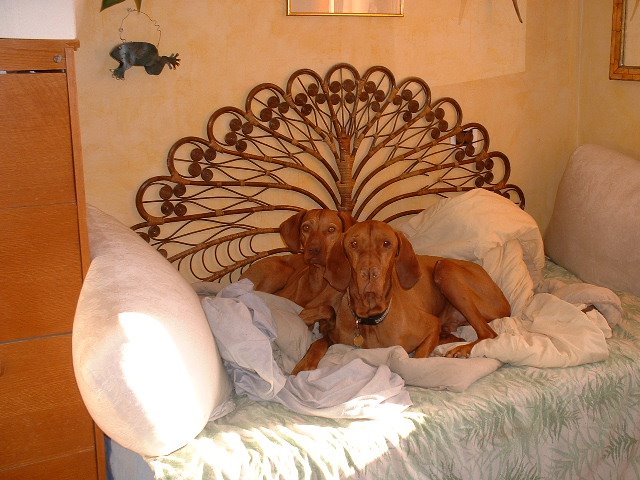
Maddie & Zak on the daybed

I go into the study. Zak, one of the Hungarian Vizlas who is staying has peed on the daybed. Zak and his sister, Maddie, always sleep on the daybed so what’s this? I strip the bed – fortunately there is a rubberised sheet underneath but the replacement protective bedding still isn’t dry as this is a repeat performance of yesterday morning. The study smells like a pissoir: a combination of Zak’s pee and bad smells from Rox, the old crossbreed, who has cystitis. The room smells of rotten fish: quite appetising just before breakfast. He’s on antibiotics so the cystitis should clear up shortly. So, that’s good, then.

Digby

I check out the bathroom: Happy, the young Lakeland terrier, has chewed a lump out of the wooden doorframe. She has Nylabones, toys galore, she plays with Digby, the dachshund all day but of course, chewing a doorframe is far more interesting.

‘I’d love to run a dog hotel like you,’ they say. I smile and nod.

Happy

11 September 2006

Café Milou


A client is sitting across the counter from me. ‘Another coffee?’ I ask. She passes me her cup: ‘Just one more and then I really must get going.’

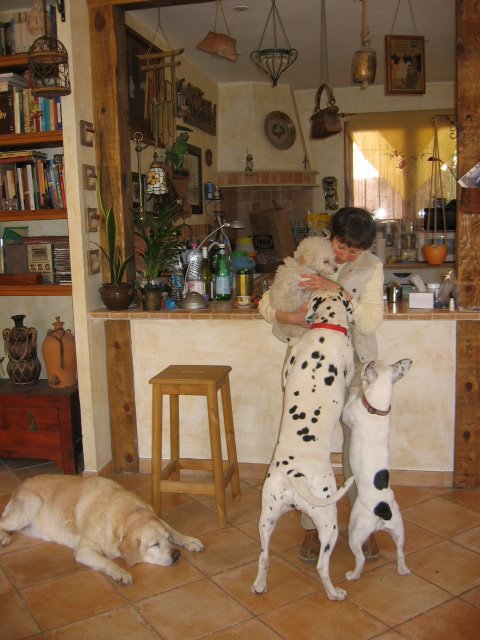
When clients bring their dogs to Pension Milou, they often stay and have a coffee or a glass of wine. Clients become friends, of course. The nature of my metier means it's often difficult to leave the dogs and so I love it when the world comes to me, if only for a coffee and a quick chat. The kitchen, a cuisine américain, as it’s called in France, opens onto the living room so we sit either side of a wide terracotta tiled counter. Wooden beams frame the opening and hanging from the crossbeam above us are bamboo chimes given to me by Youdi, a Chinese/Dutch artist friend who lives in Nice. Next is a wooden goat’s bell from Nepal and further along, a yak’s milk container from Tibet: both bought from a traveller in Menton market. There’s a large brass bell I bought in Spain and a small Lautrec print on glass hangs at the end. It all looks rather 1960's, I suppose.

When clients collect their dogs and stay for a while, their little darling, who up till then, had been playing happily with the other dogs, suddenly becomes a dervish of mock ferocity. ‘Don’t you come near MY Mum.’ Yes, we dog people refer to ourselves as Mum and Dad – and why not? Our dogs are part of our family – in some cases, dogs are all the family we have.

Charlotte (Tessa and Hattie's owner) - sitting at the counter with Pixie
We are chatting and the client asks me if I’ve ever had a dog die whilst staying here. She makes the comment that it must be something to worry about. I agree. I tell her I have a friend up the road who looks after dogs in her home, much as I do, and she won’t take old dogs for that very reason. Personally I like looking after old dogs but yes, there is always the risk one could die whilst here.

‘When I lived in Wales,’ I tell her, ‘I used to board cats: The Valley Hotel for Cats, it was called. Lordy, how original I was! I eventually built kennels to board dogs but never added the word Dog to the sign post at the top of my valley. It hardly mattered anyway, as the Welsh Nationalists defaced any signs written in English. One morning I went down to clean out the cats. In one cage were two cats from the same family and one of them was as dead as the proverbial dodo. I didn’t have a telephone number for the owners and had to wait two weeks before the family returned from their holiday. I asked my vet if he’d do a post-mortem but he said he couldn’t do that without the owners’ permission and suggested I put her body in the freezer to await their return. I barely slept for two weeks worrying about how I’d tell them, how they accept it. How do you tell a family that their adored pet has died and worst of all, in your care? The day arrived – they drove down the valley. I showed them in, took a deep breath and told them their black and white cat had died. ‘Oh, that’s OK,’ the wife said, ‘she was very old and had a heart condition and we knew she could go any minute. So sorry, we forgot to tell you.’'

I make myself another coffee. Riff, was a very old Jack Russell who had been to stay at Pension Milou three or four times. On this occasion, she arrived for a three-week stay. Her owner told me she’d not eaten for a couple of days but that this happened sometimes and anyway it was probably because she was so old. I asked if I could take her to the vet if I was worried and he said he’d be pleased if I would but again, he felt she was just a very old dog, nearly 17. That day she ate a little chicken but she couldn't keep it down. That night she slept OK but the next day she was not a well dog. Once the rest of the dogs had been fed and had a run around the garden, I sorted them out: put some in the bedroom, a couple in the study, left some in the living room and bundled Riff into the car and off we went to the vet.

The vet examined her, tested her heart, felt her stomach, looked in her mouth and told me he suspected a liver or kidney problem probably caused by her very dirty teeth and inflamed, infected gums – he didn’t think she’d last very long. Dirty teeth result in infected, bleeding gums and toxins get into the blood stream. Riff’s certainly needed cleaning but you couldn’t put a dog that old under anaesthetic, not even a light ‘calmant’ as they give here in France. I remembered another old dog I used to care for: Tigger, a Cavalier King Charles spaniel. He’d exhibited the same symptoms as Riff, the vet had given massive doses of antibiotics and happily he’d got over the infection. Later, he had his teeth cleaned, some rotten ones removed and went on to live another two years, dying when he was 16: a great age for a Cavalier. The vet gave Riff a shot of antibiotics, gave me more antibiotics in tablet form but told me he didn’t hold out a lot of hope.

When I got home, I made her comfortable in a little bed in my bathroom – she was very listless and not interested in food or water. I called her owner in London to tell her what the vet has said. ‘Oh Jilly, I don’t want her to suffer. Please take her back to the vet and have him put her to sleep.’ I told her about Tigger and asked if we could just give her 24 hours in the hope the antibiotics would fight the infection. She agreed. That evening though, little Riff took a turn for the worse. I’d been giving her water by syringe, as she wasn’t strong enough to drink. I so hoped the antibiotics would kick in as they had for Tigger. Now she started having difficulty breathing - she wasn’t long for this world. I called her owner and told her I had some sedatives for dogs who travel badly. I told her that if I gave these tablets, it would be likely Riff would never wake up but at least her suffering would be over. ‘Oh please, please, Jilly, please give them. I can’t bear to think of her suffering.’ I couldn’t either. I crushed a couple of tablets, mixed them with water and syringed the mixture gently down her throat. She lay in her bed, covered by a soft blanket, gasping for breath. I sat and stroked her till she fell asleep. She never woke up. In two hours her heart stopped beating. By then it was two in the morning.

Riff's last day
Her owners had asked me to call them, whatever time it was – of course they weren’t sleeping anymore than I was. They were so kind, so considerate of my feelings yet I knew they were devastated by the loss of their old dog. They wanted to bury Riff in their garden in Menton but they were not coming back to France for three weeks. What to do? ‘I’ll put her body in the freezer,’ I said. Well, you need to know that I didn’t have a big freezer here as I’d had in Wales. I had a small freezer compartment on top of my refrigerator. The next morning I tidied the freezer as best as I could. I put Riff into a black plastic bag and up she went into that cavern of chilled air to share space with bread, pasta and last year’s home made tomato sauce. Sometimes, over the next three weeks, after I’d taken out a slice of bread for toast, I’d have to push a leg back to get the door closed.

Three weeks later, Riff was buried under a favourite tree in her Menton garden.

Another coffee?
Related Posts with Thumbnails